

There are several things in life that seem inevitable. Death. Taxes. Jim Ratcliffe sacking random staff members. And Chelsea FC Women finding ways to win even when not at their scintillating or swashbuckling best. Not bad for a side prophesied by some to fall apart completely after the legendary Emma Hayes departed last summer.
It’s a different ball game this year. Bompastor’s no longer new to the English game and Chelsea are once again tipped as the team to beat. The opening game against Manchester City provided a good first test for an ever-evolving Blues lineup and also had the added spice of Chelsea facing a third Manchester City coach in 6 months, with Andrée Jeglertz - formerly the Danish National Team coach - taking the helm at the Citizens. So how did Chelsea ensure their season started off on a winning note?
The home side lined up in 5-2-3 formation, matching their system which worked so well in the FA Cup Final trouncing of Manchester United. Hannah Hampton, fresh from European Championship glory started in goal, with CFCW Player of the Year Nathalie Björn, captain Millie Bright and fellow Lioness hero Niamh Charles deployed in the centre of defence. Sandy Baltimore and new signing Ellie Carpenter were in the right and left wingback roles. A solid axis of another victorious Lioness - Keira Walsh - and the indomitable Erin Cuthbert sat in the middle of the park, with the energetic young duo of Wieke Kaptein and Maika Hamano given free roaming roles. This left prodigal Cobham starlet Aggie Beever-Jones - she also of European Championship glory - to lead the line.
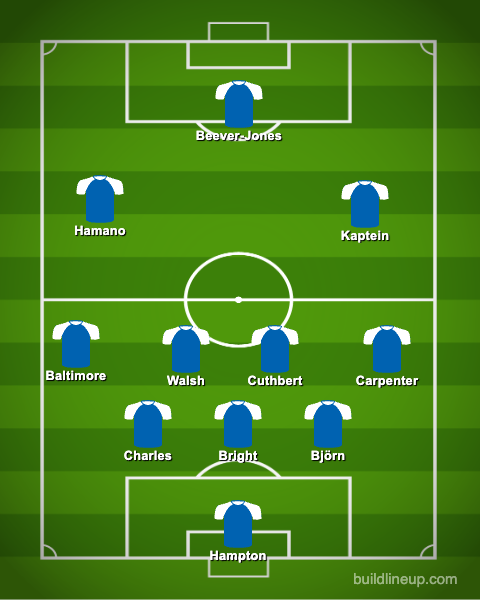
Manchester City themselves had lined up in a 4-2-3-1 formation, with Yamashita in goal, a back-four of Kerstin Casparij, Jade Rose, Grace Prior and Alex Greenwood, Yui Hasegawa and Sydney Lohmann in midfield with Lily Murphy and Lauren Hemp on the left and right respectively, Viv Miedema in the 10 role and Bunny Shaw up top.
It was very clear that Bompastor’s formation favoured the options and fluidity a 3-ATB formation provided. During early spells of Manchester City pressure, both Hamano and Kaptein were expected to drop back into the midfield to create further congestion and block Manchester City’s passing lanes. In particular, Chelsea were keen to isolate Yui Hasegawa’s ability to punch the ball into Miedema in pockets of space, and to also ensure Sydney Lohmann lacked easy chances to burst forward. City started off on the front foot with a very aggressive press and for several minutes, Chelsea were happy to frustrate and contain whilst they worked out the City shape.
This approach paid dividends and Chelsea were able to exploit the City press effectively. CFCW often pushed into an asymmetrical 4-2-3-1, especially on counters with Hamano or Kaptein tucking inside into a more traditional 10 role which allowed Baltimore, or Carpenter (especially in the first half) to burst on and play in a more traditional wide winger role. This shift in pressure meant that Chelsea could box Manchester City in, particularly when they tried to play out from the back. Beever-Jones’ ability to relentlessly hurry and press the defence made it more difficult to play out into Hasegawa, and this left City often going down the channels, playing low-percentage passes which were cut out by the Chelsea high press, or simply resulted in the ball going out of play.

As mentioned earlier, Chelsea’s biggest success was their ability to stop Yui Hasegawa in the first half being able to play on the half-turn and pass into either Bunny Shaw or Viv Miedema. The latter was so frustrated by this she was often dropping deep trying to get the ball and this was further breaking the options that Manchester City could play through. Although Hasegawa did see a lot of the ball and had a lot of touches, she was often forced to either pass backwards to Rose and Prior, or wider to the Manchester City fullbacks. In particular, this didn’t work on the left-side as Greenwood is predominantly a defensive left-back (and more recently has been deployed as a central defender).
With Casparij and Greenwood pushed forward, this forced both Hemp and Murphy inside and so instead of exploiting any space behind wingbacks, they were forced to instead continually have to beat multiple players to create space. The extra central defender was also able to help Chelsea sweep up, especially with the free-roaming Erin Cuthbert also supporting from a defensive role. It also meant that both Hemp and Murphy ended up dropping further back to offer defensive cover and sometimes due to Greenwood tucking in, Hemp ended up in a right wingback role herself. Although Jeglertz could have been looking to try something like this to counterbalance the speed and directness offered by both Baltimore and Carpenter, it severely limited City’s ability to create havoc in the wide areas.
In build-up, Chelsea instead used Charles and Björn as wider options, moving them towards the edge of the penalty box and allowed Walsh to tuck into the middle of the defensive third. This ensured Hampton always had multiple options to play out through, and facilitated forcing the City press. This was particularly prominent on the right-side as Hemp led the press and this resulted in Casparij stepping up to try and intercept. This shifted the entire side across significantly and with several quick passes, Chelsea were able to manipulate the ball across to the other central defender to burst out.
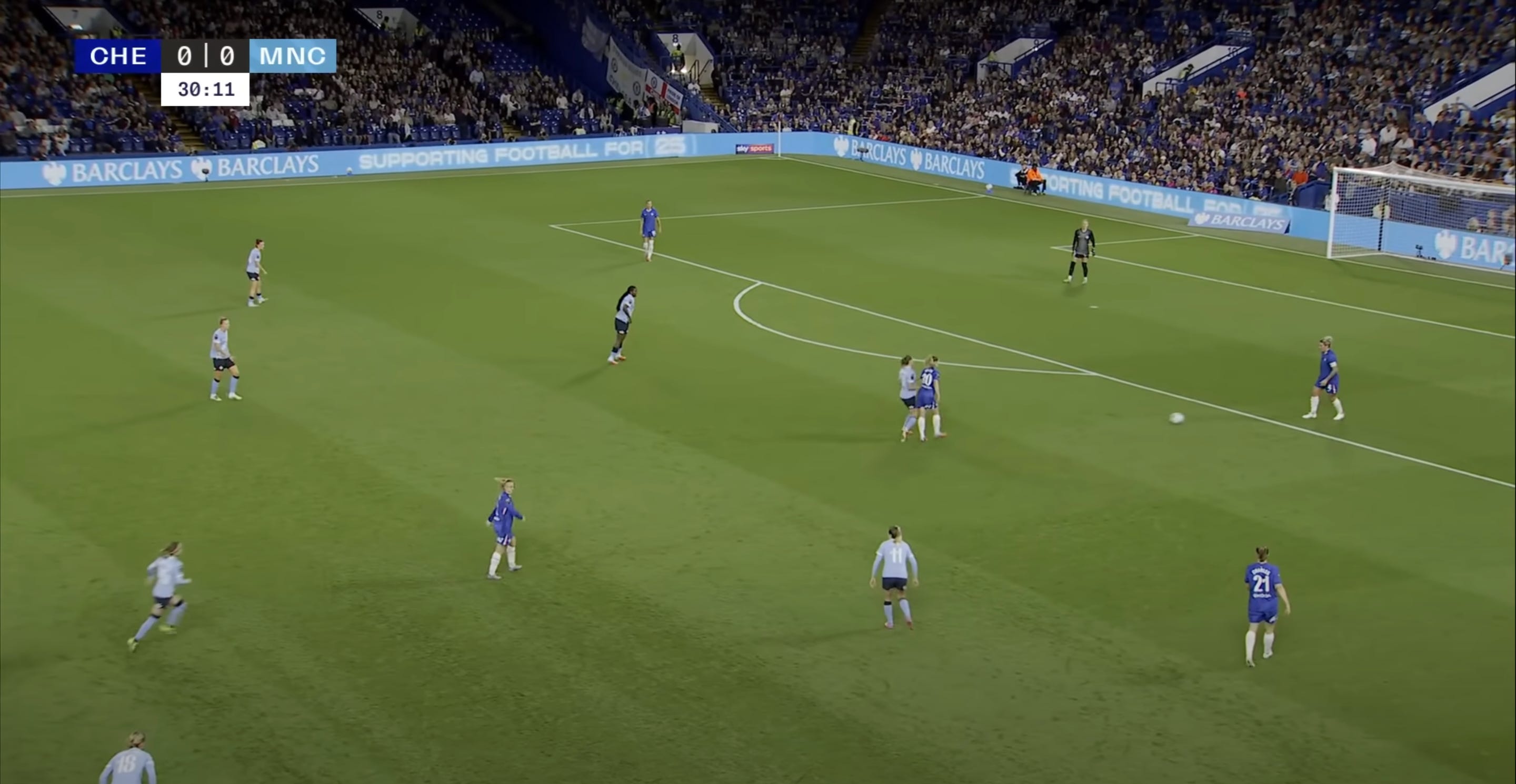
You can see this scenario play out perfectly in the extended build-up to the first goal. Chelsea win the ball back and play the ball to Millie Bright. She has 4 passing options of varying difficulty. Across the box to Björn (risky), back to Hampton (safe), vertical to Cuthbert (somewhat risky) and out to Charles (safe). The pass to Charles causes City to try and intercept and press, but a quick one-two between Walsh and Baltimore gives the England international a huge area to operate in and crucially, takes 3 City players out the game. Hamano’s also dropped deep which has dragged Hasegawa across…
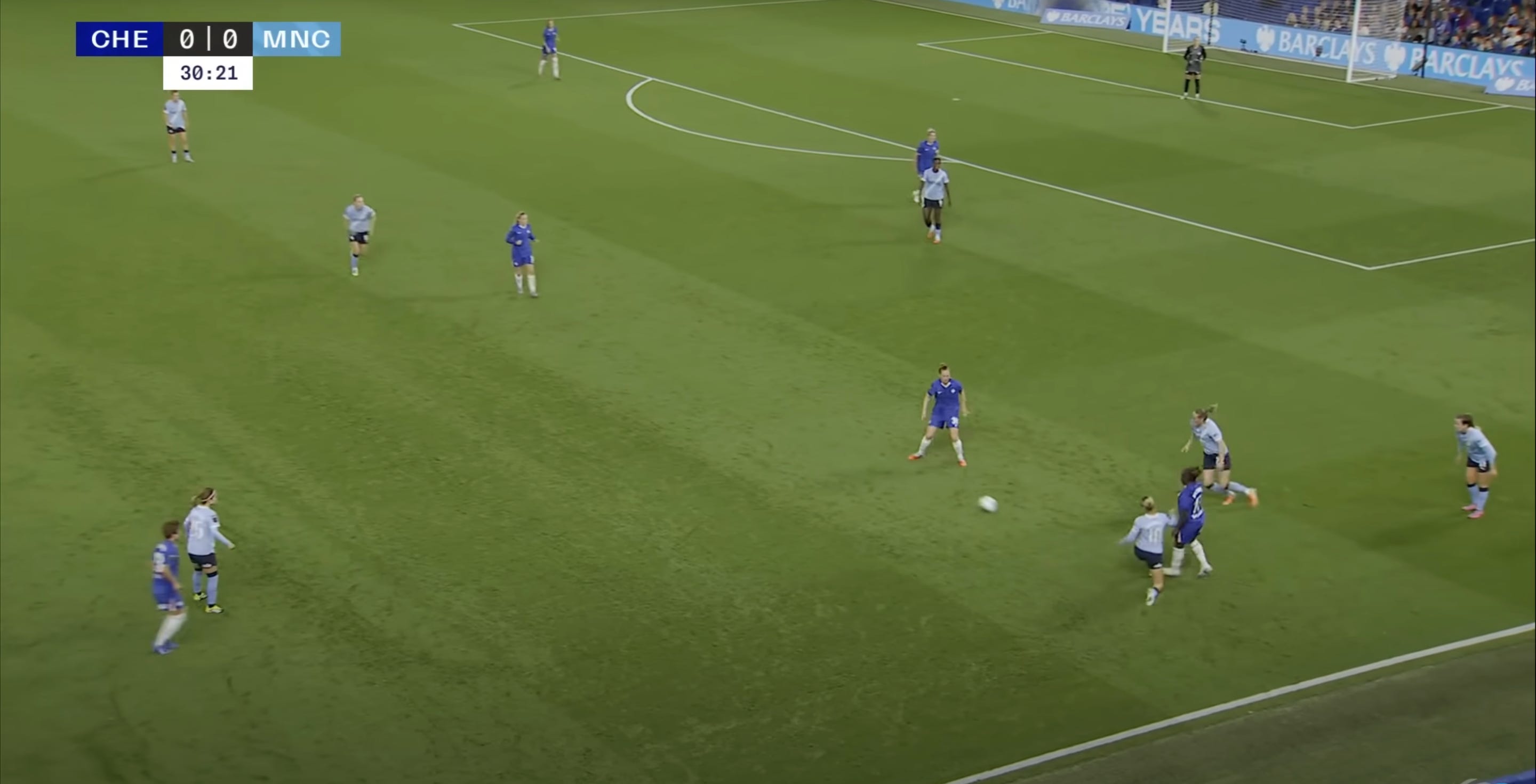
And because Miedema can’t resist trying to intercept, once Walsh plays her pass across, it leaves Erin Cuthbert in acres of space. Lily Murphy’s caught exactly where she doesn’t want to be. Does she try and intercept, does she cut the passing lane to Björn or try and track back against Carpenter? Björn’s already on the move…

As is Ellie Carpenter! And as Chelsea have moved City out of their initial structure and shape, the entire City line has pushed forward and that allows Björn to slot a very inviting through-ball for the Australian to charge onto. Greenwood’s a very good 1-on-1 defender in terms of reading the ball, but she doesn’t have the speed to match Chelsea’s right wingback…
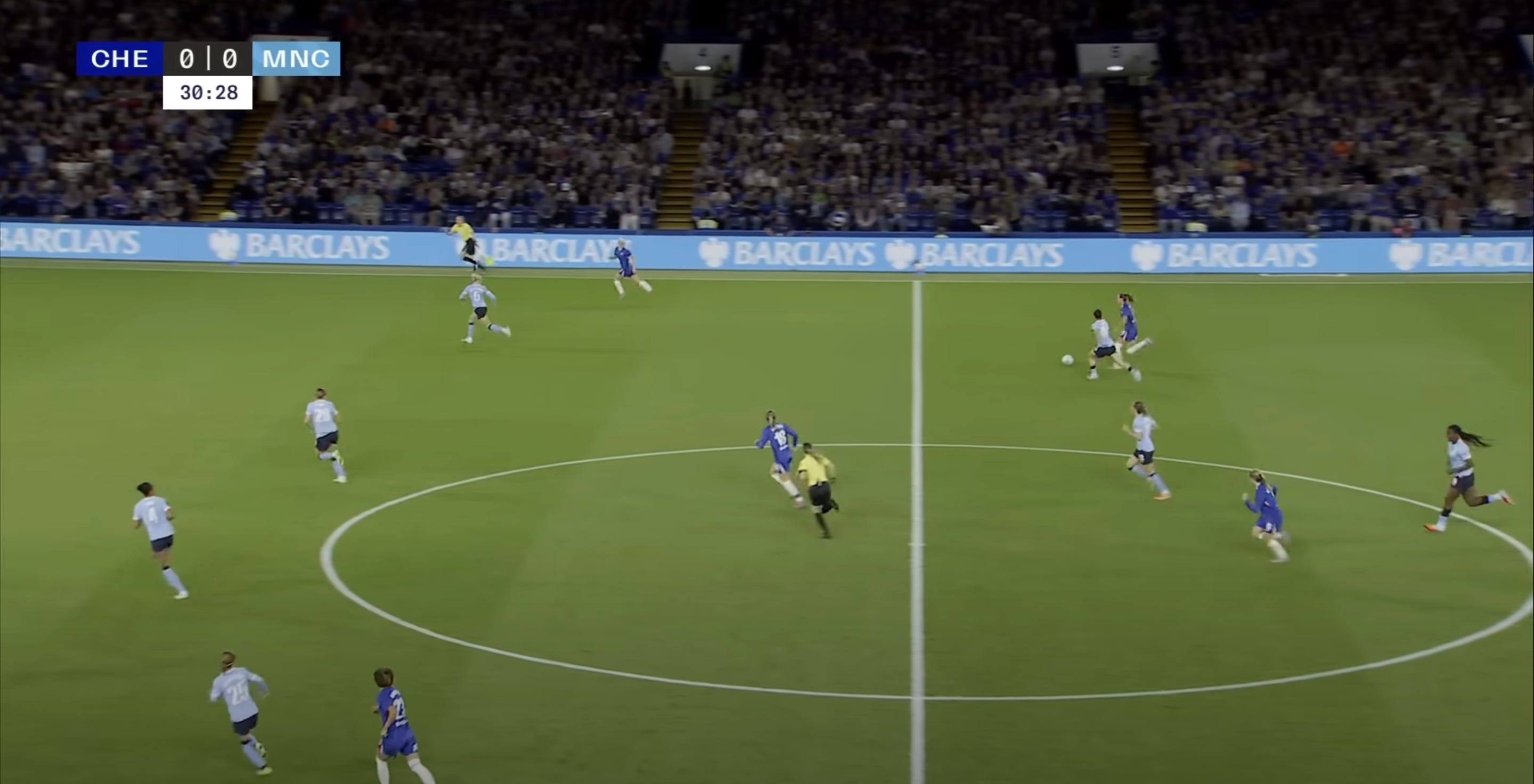
Meanwhile, Aggie Beever-Jones has peeled off into the space behind Jade Rose. Again, you can see Hasegawa knows what is coming as Casparij still isn’t back into the space to cover and neither Rose nor Prior are following Beever-Jones as they have both been dragged across to try and block the incoming cross…

And this leaves the English striker free to dart into the space between the two of them and tuck a simple finish past Yamashita! Simple eh?

You can see the frightening nature of how quickly Chelsea shift from Gear A to Gear. Millie Bright is considering playing a pass back to Hampton and 19 seconds later, Beever-Jones is celebrating. It is that ruthless level of efficiency which has set Chelsea apart in the last season.
At the other end, in terms of defending against Bunny Shaw, Chelsea took an interesting approach of letting her have space around the edge of the penalty area, or earlier in the middle third, but did not let the ball be directly played up to her. When it was played like this, they were reluctant to let her have room to turn and used Bright and Björn to contest primary duels, with the latter mopping up second-balls. Shaw’s main chances in the 1st half all came from individual mistakes, with Bright and Björn both guilty of misreading balls over the top. Hampton was able to push the first effort sufficiently wide, and made a very good save for the second one, which was right after Chelsea had scored. In the second half, Shaw actually did drift a little bit wider to try and focus on Niamh Charles, perceiving her lesser aerial ability to give her a better chance of dominating. This, however, did leave City without a central focal point to play into at times.
City’s other main central attacking threat was expected to be Miedema. The Dutchwoman has had a mixed record against Chelsea but did torment the Blues in the first leg of the UWCL Quarter Final last season. With this in mind, Chelsea deployed Erin Cuthbert in a nominally defensive midfield role, but due to the rotations of Hamano and Kaptein, as well as the 3-ATB formation, she had liberty to roam more as an 8, especially in the middle third. In contrast, Keira Walsh did predominantly sit deeper. Cuthbert’s superior recovery pace and ability to disrupt City breaks ensured that the Citizens rarely found Miedema in pockets of space. At times, Cuthbert effectively shadowed her, which reduced the options further for Yui Hasegawa from a central POV.
In the first half especially, it felt like City were happy to be disruptive, rather than control play. After half-time, they did adjust to the Chelsea system and for the first 10 minutes, had sustained spells of control and pressure in the final third. However, this did also lead to opportunities for Chelsea for more fast breaks.
City already had one warning sign. Again Chelsea keeping possession and move players around, eventually sending it wide to Baltimore who uses the space behind Casparij to play the ball into the channel for Beever-Jones…

Once again, one pass has unlocked the defence and ABJ has a 1-on-1 against Grace Prior. She makes space, but the finish this time is lacking.
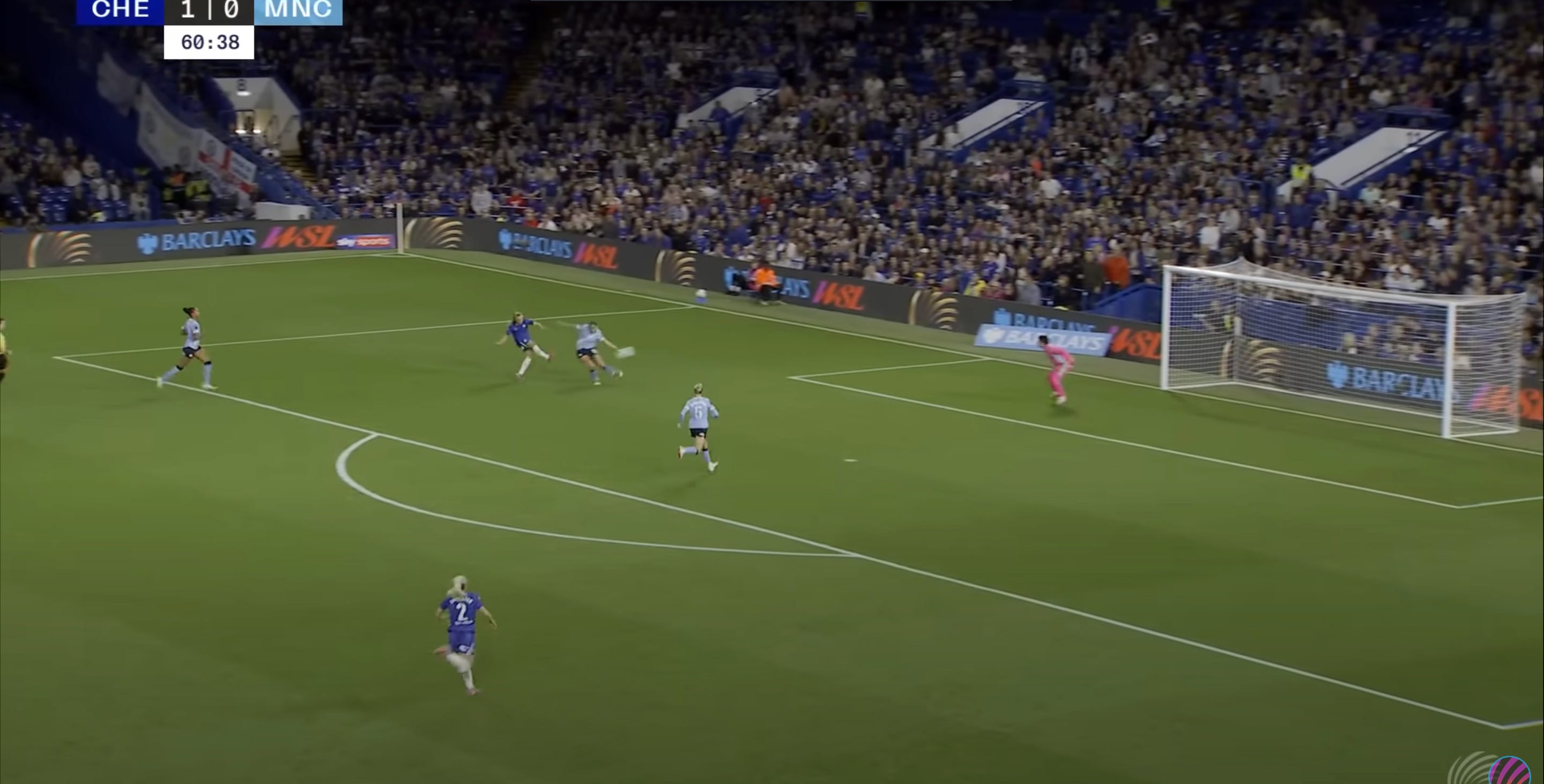
It’s another example, however, of how much space there is in the wide areas and how by getting the right ball into the final third is going to guarantee CFCW a high quality chance.
ABJ immediately is replaced by Catarina Macario, which not only gives Chelsea fresh legs, but also offers a more central option to play into. Macario rather than run into wing channels instead has a better ability to play with her back to goal and also bring others into play. You suspect Bompastor’s decision to sub her on is because she’s noticed the amount of space already available as City are pressing higher and again struggling to retain their shape. They are conceding high quality chances on the transition, which is a real area of strength for Chelsea.
Again, it starts at the back with Björn having multiple passing options. This time she’s going wide to Ellie Carpenter.
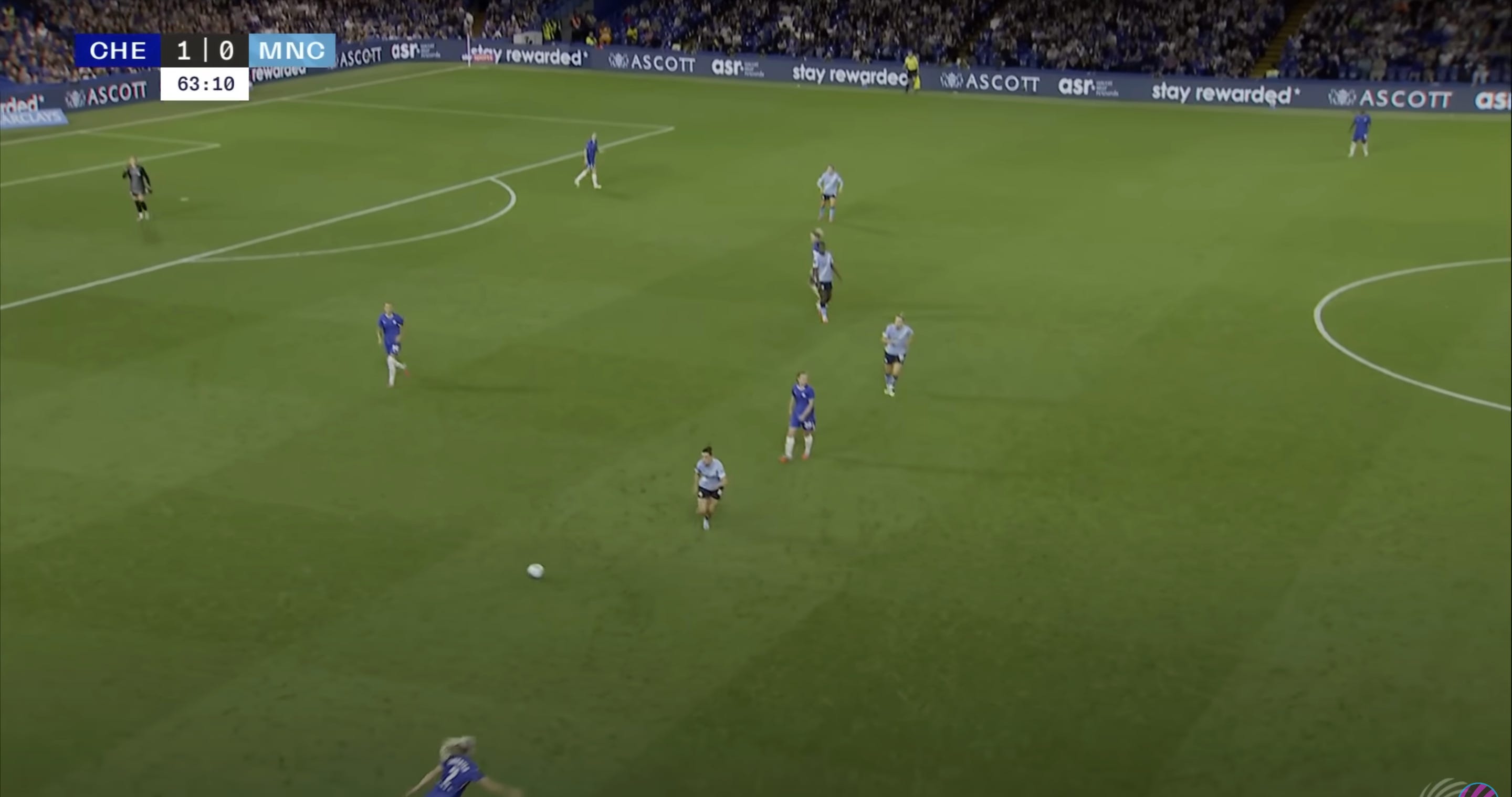
The Australian accelerates and suddenly Chelsea have a lot of space again. Wieke Kaptein is already moving from the midfield into the wing space and although Alex Greenwood is aware of her, she’s on the wrong side from a defensive POV as Chelsea have already triggered and broken the City press. Macario’s also made a clever run in front of Grace Prior so when she receives the pass…

She can ‘bounce’ the ball into the space behind Alex Greenwood, which Wieke Kaptein has charged into. Greenwood chooses not to foul her as she is always on the wrong side. If she commits the foul, does she risk a red card? Hard to say.

Kaptein’s able to get into the box and deliver a low cross. Again, having started the move, Macario’s clever movement between the two defenders has caught the attention of Jade Rose. She recognises the American is in behind Grace Prior and is the likely target for the cross, which leaves Maika Hamano in acres of space.
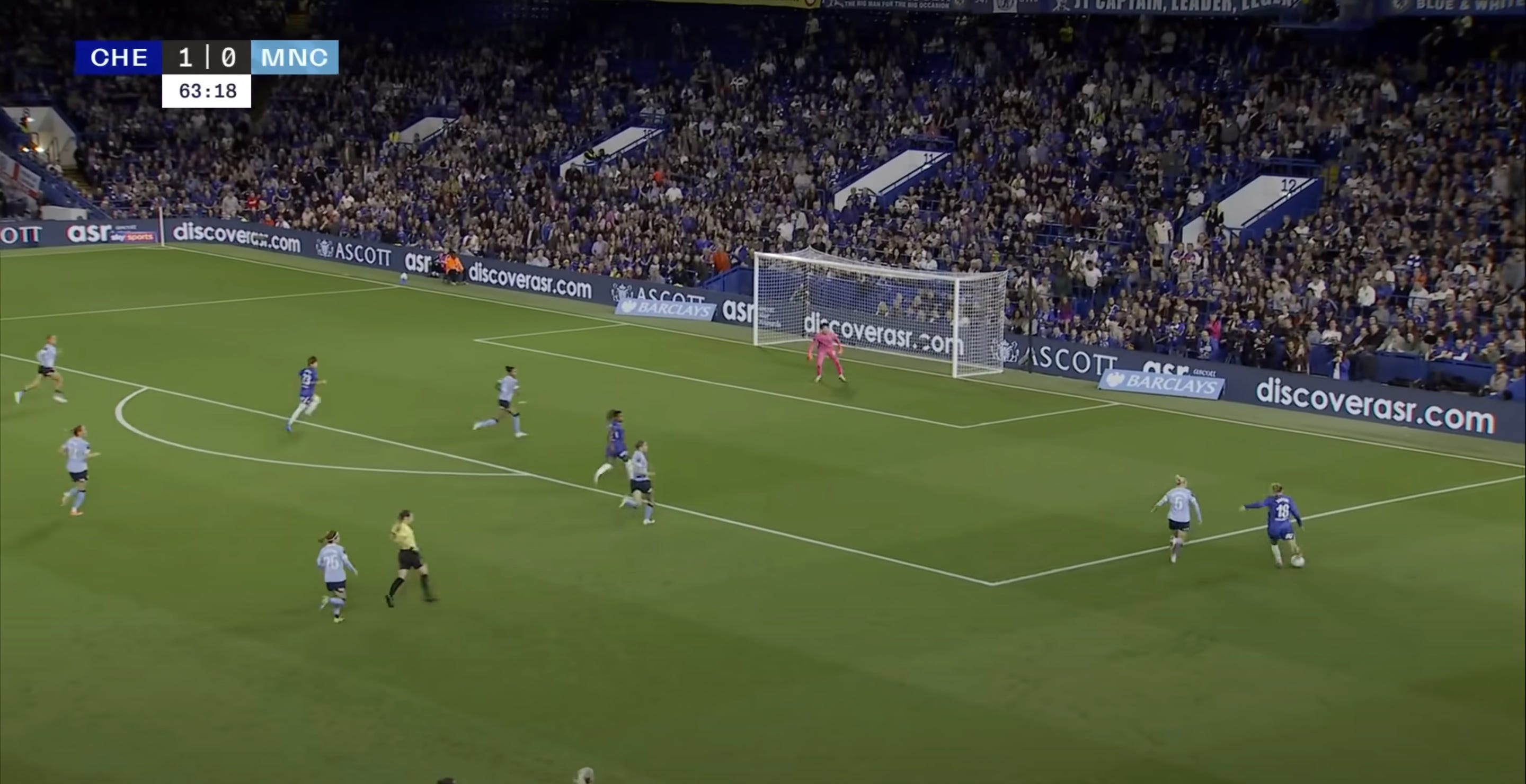
And Macario’s clever dummy deceives Rose completely, leaving Hamano with a very simple high xG chance which she finishes comfortable.
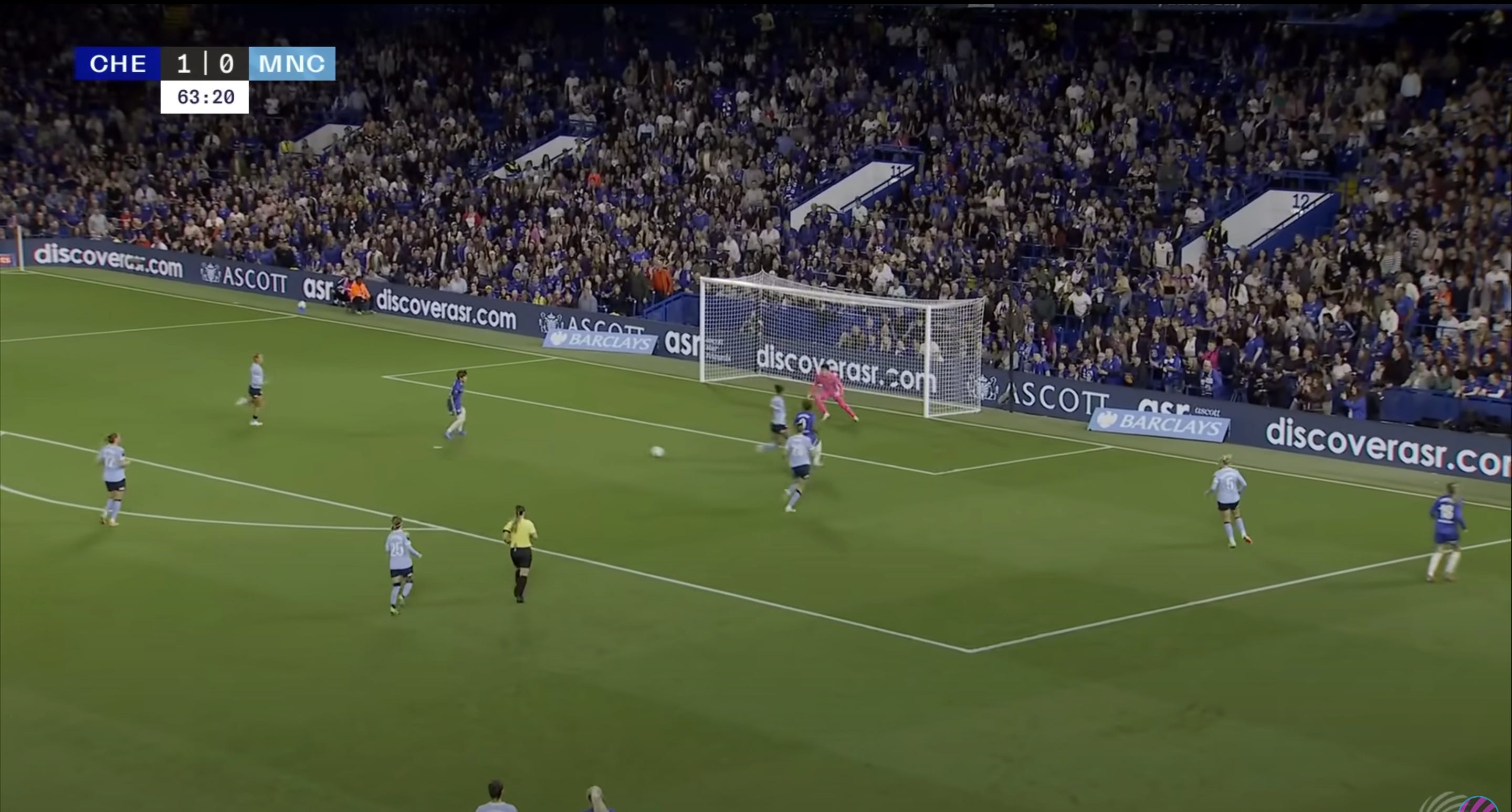
Again, speed of action and precision of action is key. In just 10 seconds, Chelsea go from Björn passing the ball barely 30 yards in front of Hannah Hampton to Maika Hamano celebrating the finish.
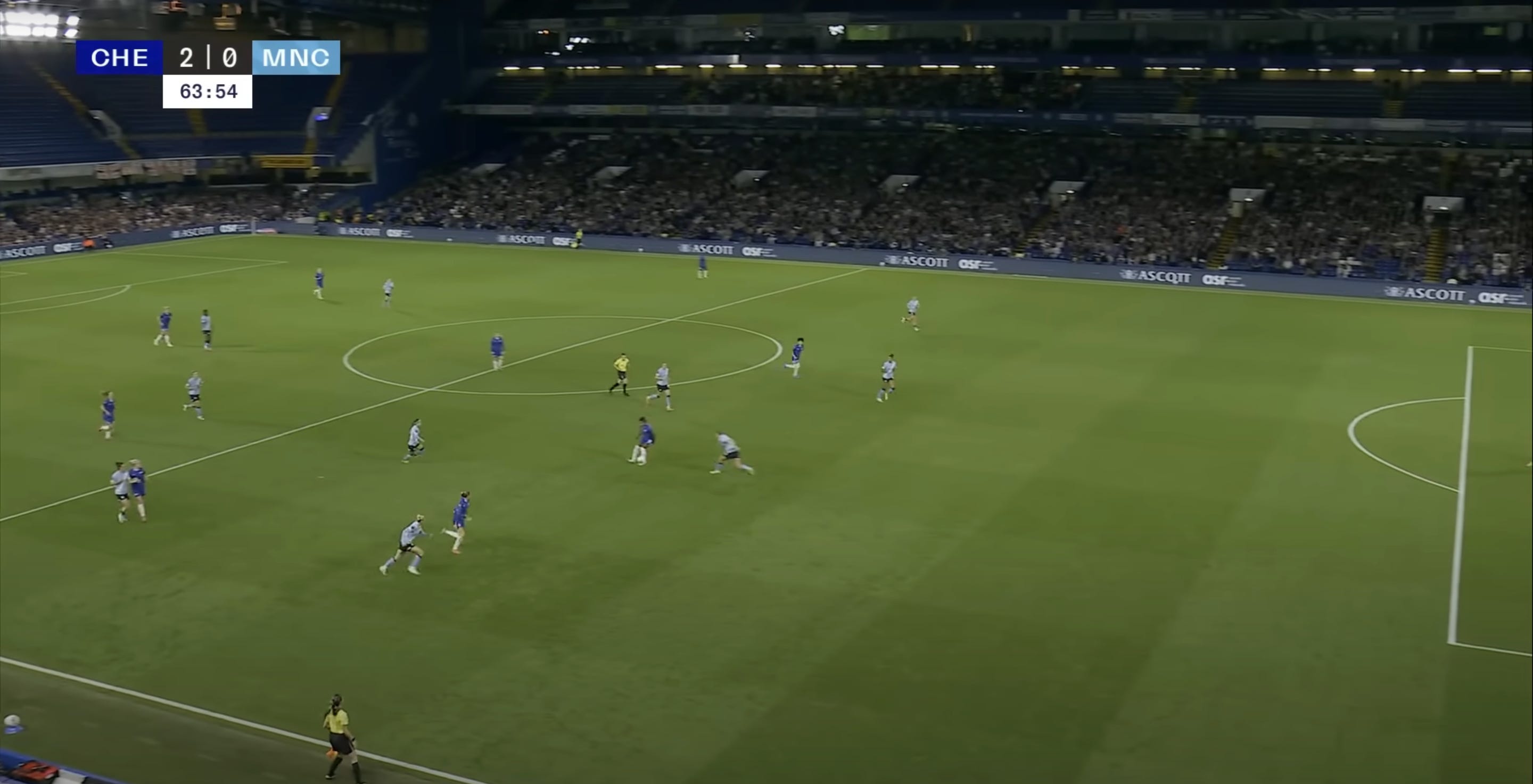
Off the ball movement is absolutely key. Again, Chelsea Manchester City in a lopsided shape with 8 City outfielders in the right side of the pitch. No one is tracking Hamano who has squeezed into the space between fullback and centre-back. Jade Rose ends up in a difficult 2 vs. 1 decision - whether to follow Macario or stay with Hamano. In the end, she has to do the former because Prior hasn’t tracked the American.
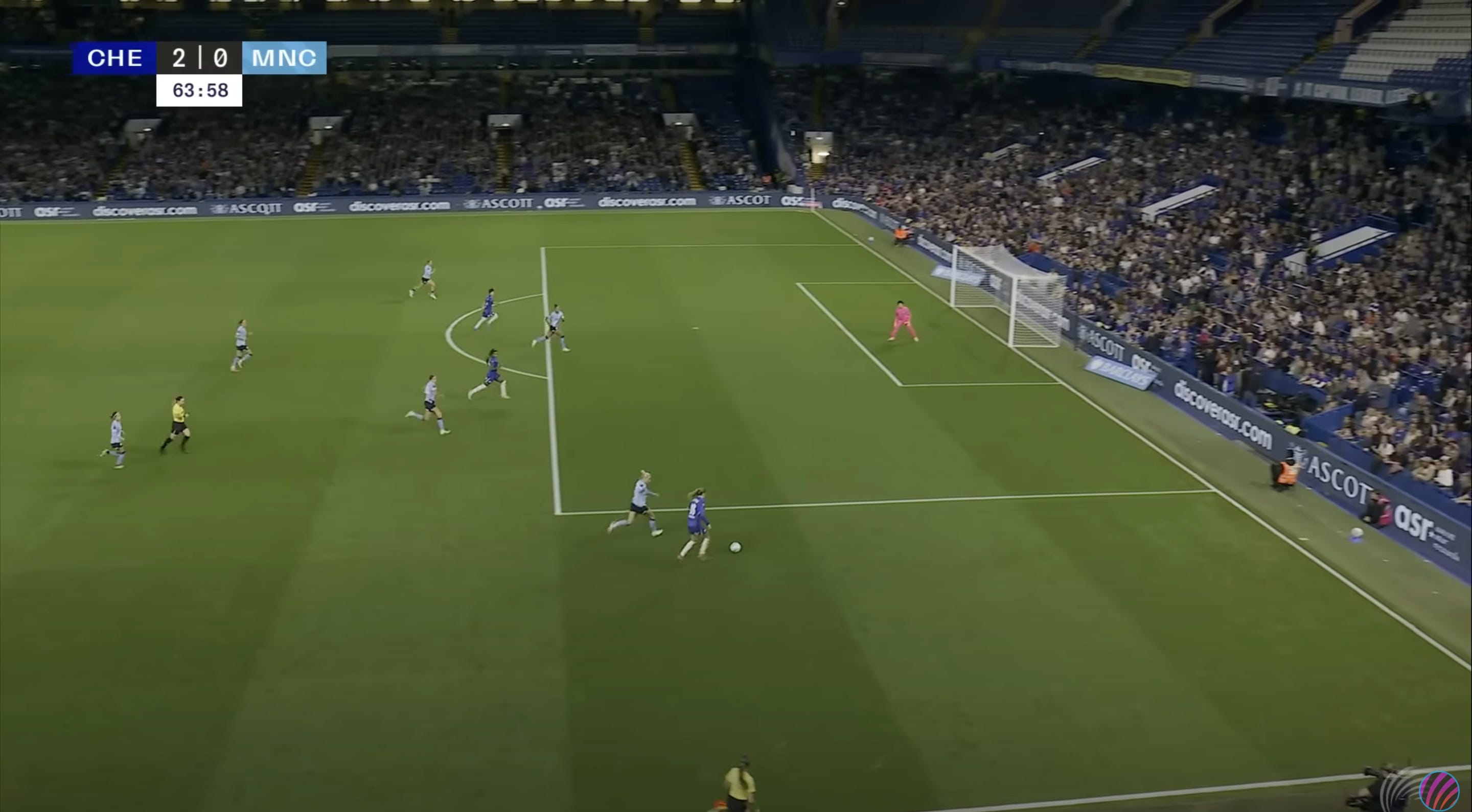
To try and get back into the game, City did allow Lauren Hemp to drift into more central positions, particularly in the second half. She did create the most chances in the match, however, perhaps crucially from a Chelsea POV, a lot of these were either more speculative, resulting in low xG efforts from around the edge and outside the box, or alternatively fell to the wrong player. A prime example of this is Yui Hasegawa. The Japanese midfielder had one half-volley which she caught too sweetly and fired straight at Hampton. She also had an ambitious flicked effort which rolled agonisingly wide. However, if it had been Miedema or Shaw on the end of those efforts, the outcome may well have been different. It’s worth noting both of these chances also came at 1-0.
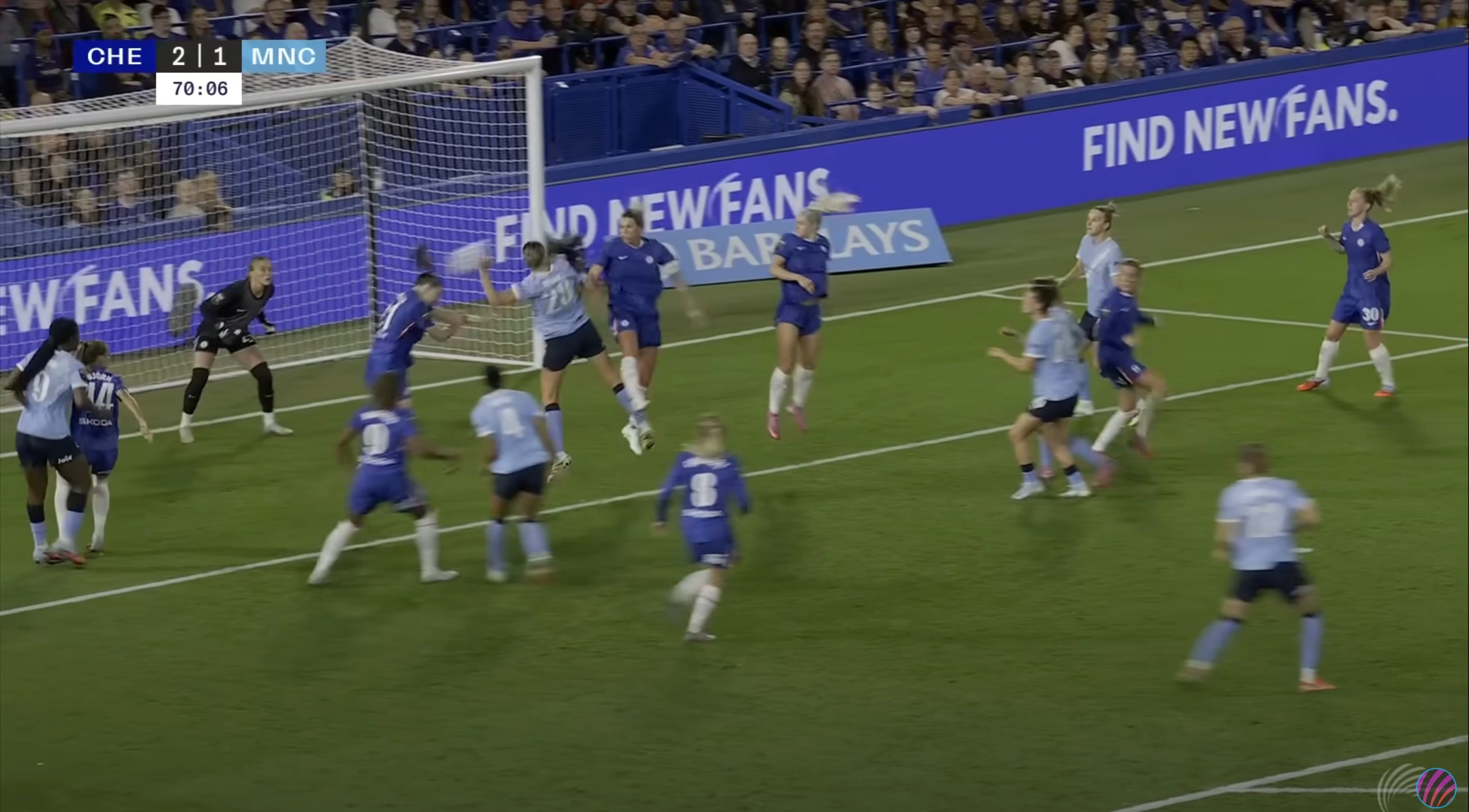
City were able to pull a goal back, through Niamh Charles’ own goal and it would be remiss of me to not analyse this a little bit. Initially, the lineup at the set-piece has some problems.
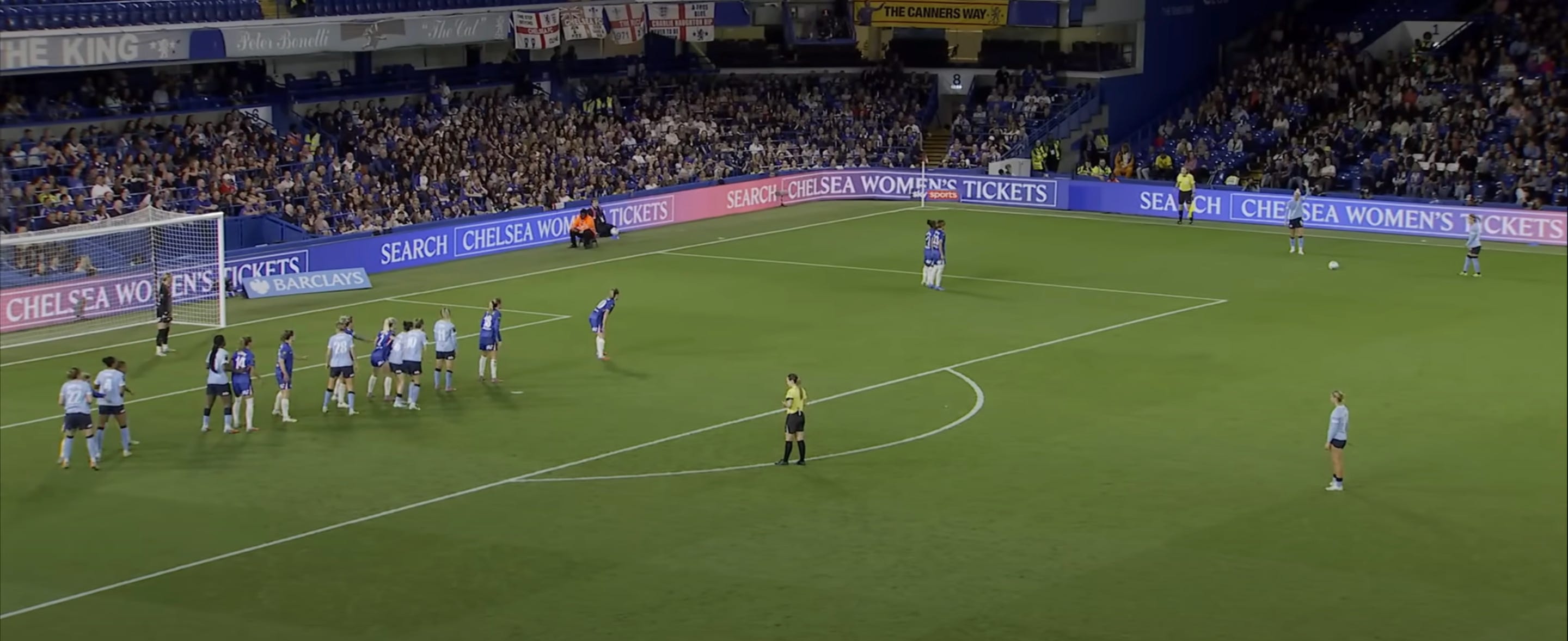
Let’s be honest. The wall of Sandy Baltimore and Maika Hamano isn’t going to stop a lot. Miedema’s completely free and going to lose her vague semblance of a marker, moving into the space between Kaptein and Walsh at the near post to cause chaos. Greenwood’s delivery is good and both Bright and Carpenter leave their players to try and head the delivery away -- both miss the ball.
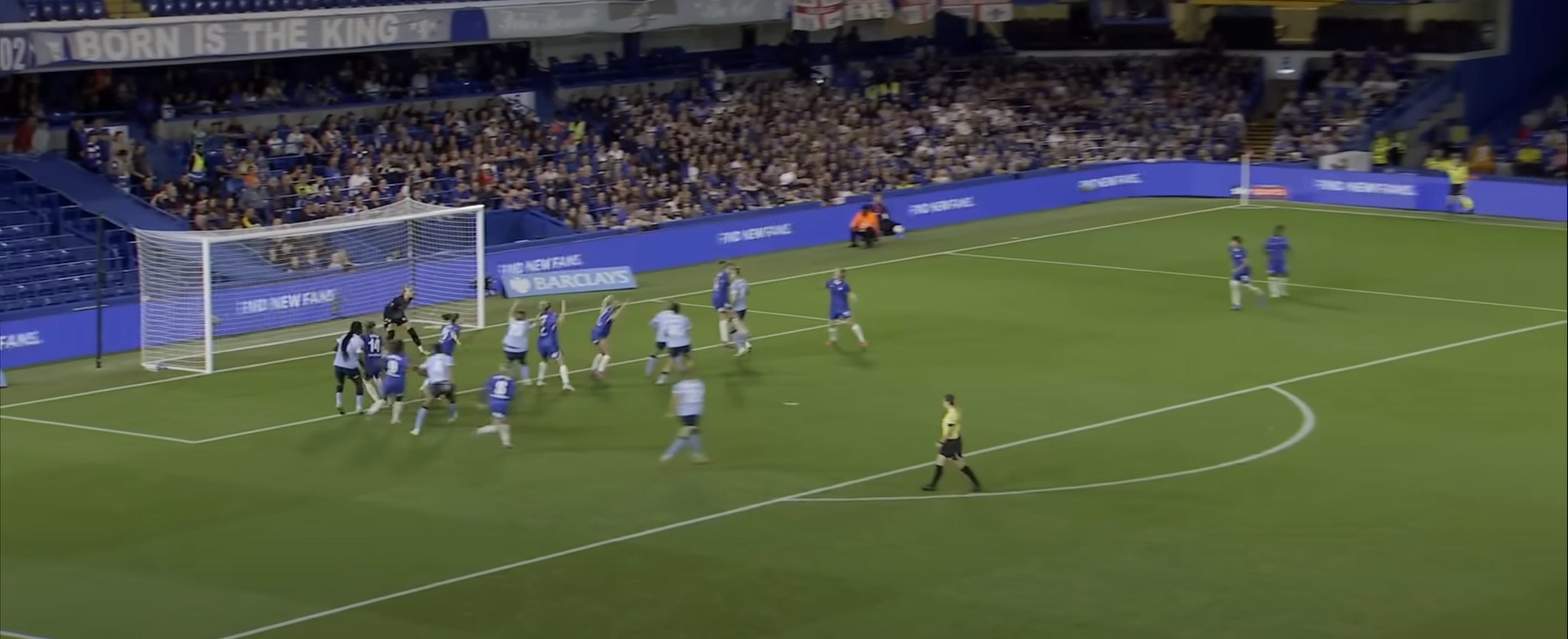
Meanwhile, Niamh Charles - who again has started off marking Grace Prior allows Prior to get the wrong side of her. Between Bright and Charles they give Prior a free header. The City defender gets first contact, her header bounces off Charles - who doesn’t really know where she needs to be - and gives Hampton absolutely no chance to react.
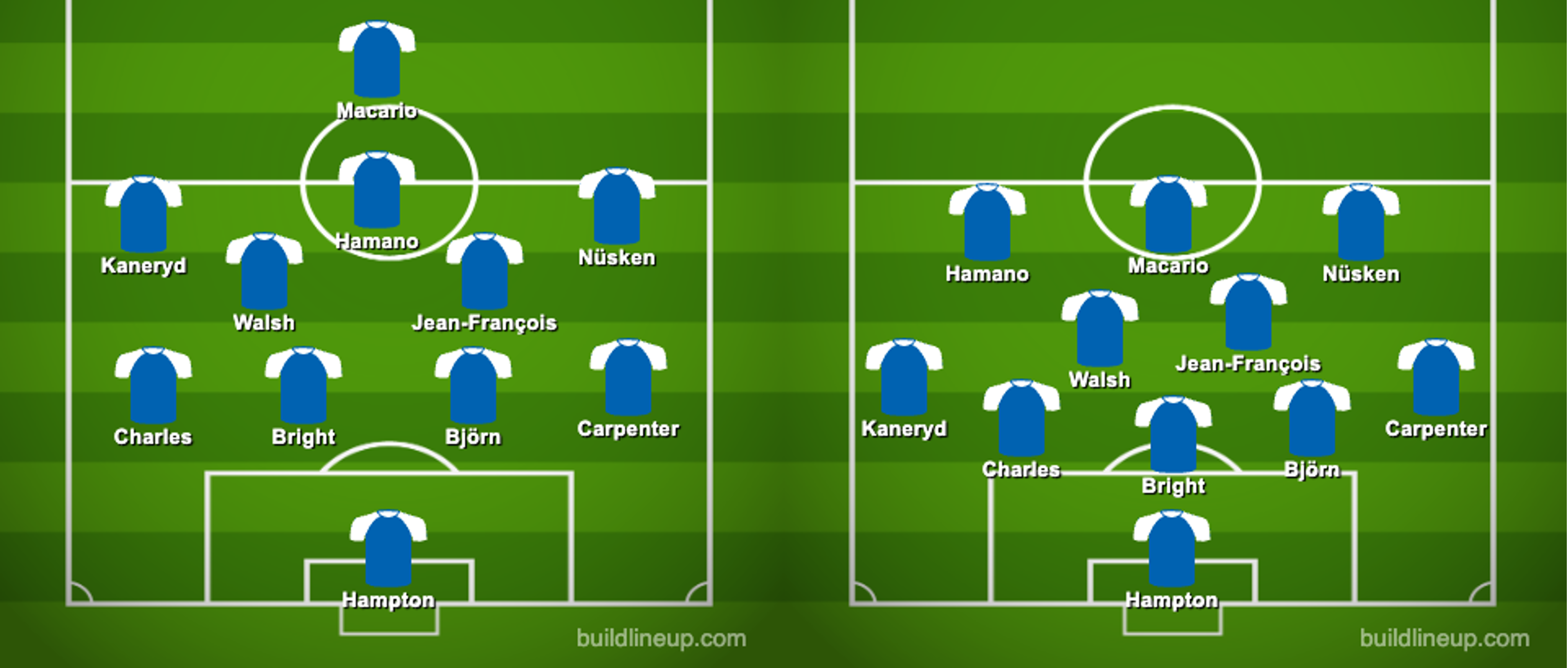
To combat the expected wave of City attacks, Chelsea switched into a more rigid 5-4-1 when defending and 4-5-1 when in possession. They forced City to try to break them down, whilst keeping the spaces compact and lines tight. Carpenter moved from a wingback role to a more traditional rightback role in possession, with Charles also dropping into a conventional left-back role.
This allowed substitute Johanna Rytting Kaneryd to play as a left midfielder in possession, and drop into the wingback area when defending, using her pace and fresh legs to combat Lily Murphy, who had swapped wings with Hemp. Bompastor also chose to bring on Oriane Jean-François for Erin Cuthbert. The Scot had took a knock, but the French midfielder was also happier to sit in and disrupt, allowing Chelsea to keep their new shape. German international Sjoeke Nüsken was also brought on to add fresh legs for the tiring Wieke Kaptein, resulting in these two shapes in the final stages.
Despite a couple of minor nervy moments, Chelsea were able to see out the win with relative comfort, and remain unbeaten under Sonia Bompastor in the Women’s Super League. In doing so, they demonstrated great positional and tactical flexibility, as well as a sheer bloody-mindedness that has become a hallmark of the great Chelsea teams over the years.
The opening day victory over Manchester City Women marked a 23rd consecutive match unbeaten in the Women’s Super League too. However, for a dressing room that domestically will only have one goal in mind, it’s simply one game down, twenty-one more to go.
Rob Pratley
Excellent tactical review of Chelsea Women's win against Manchester City Women, Rob.
Excellent analysis Rob. From a simple eye test being in the crowdI couldn't get over how relentless Hamano was. She was everywhere - incredible engine!